The main language is English and it's currency is the dollar.
viernes, 20 de febrero de 2015
Introduction
Australia is south of the Equator, in the Southern hemisphere. It's the smallest continent in the world. There are over 20 million people living in Australia. Is divided into six states and two territories. The capital city is Canberra.
The main language is English and it's currency is the dollar.

The main language is English and it's currency is the dollar.

jueves, 19 de febrero de 2015
Fauna
The Australian Fauna is extremely diversified, with animals unique to Australia such as the Kangaroo and the Koala. The Australian Government has a very good system of protecting the environment, including heavy fines for any person who tries to interact with wild animals. The rule is simple, each one is stay in their own place, doing the own biological and natural function and the minimum possible environment intervention. Any type of animal, either dangerous or not, must be left alone, and never to be killed unless in situations of self-defense.
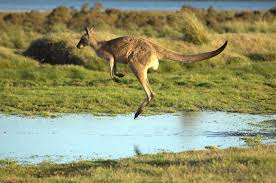
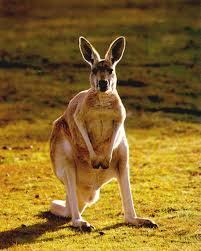
Kangaroo
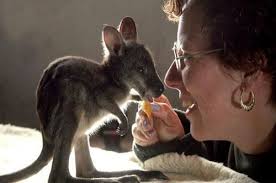
With their powerful hind legs, kangaroos can jump 9 m (30 ft) in one hop and move 64 kilometers per hour (40 mph) when in a hurry. They need their tails to help them balance as this form of moving works better at fast speeds than slow speeds. But they can't walk backwards! Kangaroos need little water and can survive without it for months. They can also dig their own water wells. Like other marsupials, female kangaroos have a pouch in which they carry and nurse their young.

Typical food
Seafood is abundant and popular in Australia along with large portions of meat such as beef or lamb roasts. Australia also is known for its wonderful fruits and vegetables.
The wine industry is prevalent in the south of the country. A typical day of meals for Australians could look something like the following:
Breakfast: cereal and toast or eggs and bacon
Lunch: sandwiches, salad, and fruit
Main Meal: meat or seafood with vegetables, dessert (Brewer).
Art
Australian Indigenous art is the oldest ongoing tradition of art in the world. Initial forms of artistic Aboriginal expression were rock carvings, body painting and ground designs, which date back more than 30,000 years.
The quality and variety of Australian Indigenous art produced today reflects the richness and diversity of Indigenous culture and the distinct differences between tribes, languages, dialects and geographic landscapes. Art has always been an important part of Aboriginal life, connecting past and present, the people and the land, and the supernatural and reality.
Flora
There are an estimated 27700 plant species in Australia, including living fossils such as the cycad palm and the grass tree, and brilliant wildflowers such as the waratah, Sturt’s desert pea, banksia and kangaroo paws.
We also have around 2800 species of eucalyps, and 1000 species of acacia, which we call "wattle". The Golden Wattle is Australia's floral emblem.


We also have around 2800 species of eucalyps, and 1000 species of acacia, which we call "wattle". The Golden Wattle is Australia's floral emblem.
sábado, 7 de febrero de 2015
History of boomerang
A boomerang is a thrown tool, typically constructed as a flat aerofoil, that is designed to spin about an axis perpendicular to the direction of its flight. A returning boomerang is designed to return to the thrower. It is well known as a weapon used by Indigenous Australians for hunting.
Boomerangs have been historically used for hunting, as well as a sport, and entertainment. They are commonly thought of as an Australianicon.
The oldest Australian Aboriginal boomerangs are ten thousand years old, but older hunting sticks have been discovered in Europe, where they seem to have formed part of the stone age arsenal of weapons.

Suscribirse a:
Entradas (Atom)